Sunday, October 20, 2013

Wormholes Period 5 Group 3 (Jeff, Shashank, JingJing) Post # 3

Wormholes 

          From our research we concluded that wormholes do exist and it is possible to travel through one, but there are many many implications. As mentioned in the post before, wormholes would collapse far too quickly to used as a form of transportation. But as mentioned before, it is possible to keep a wormhole up for long enough so that travel through it is possible. In order for it to be stable, exotic matter must be introduced into it. 
         What is exotic matter? Well scientifically it is matter with a negative energy density. This might sound counter intuitive but it simply means matter that is more than nothing. This seems almost impossible, because the most that one could do was to remove the matter itself and be left with just a vacuum. But with quantum physics, it has been proven that it is possible than an area in space can be less than nothing, and thus have a negative energy density, or its energy per unit of volume would be negative. As quoted from an article

            "The concept of negative energy is not pure fantasy; some of its effects have even been produced in the laboratory. They arise from Heisenberg's uncertainty principle, which requires that the energy density of any electric, magnetic or other field fluctuate randomly. Even when the energy density is zero on average, as in a vacuum, it fluctuates."
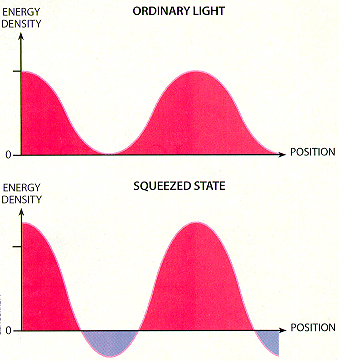
Heisenberg's uncertainty principle suggests that the energy density of any field that is electric of magnetic fluctuates, so that of the field as a whole has an average of zero energy density, then some parts of the field would have a positive energy density, which also supports the fact that other places must have a negative energy density to counteract this positive density.
"Waves of light ordinarily have a positive or zero energy density at different points in space (top). But in a so-called squeezed state, the energy density at a particular instant in time can become negative at some locations (bottom). To compensate, the peak positive density must increase."


Why is this negative energy necessary?
         Through our research, we came across many physics topics that are still very complicated and hard to explain, but can be somewhat understandable. It is understood, through the work of Stephen Hawkings, that black holes radiate energy. Remember that wormholes consist of two black holes as mouths.
But how can a black hole radiate energy if not even light can escape it?
          This comes into conflict with some laws of thermodynamics which state that energy is conserved. Because at a black holes horizon, the point "of no return" where not even light can escape, energy is only going in. In order to counteract this, because energy is always at a thermodynamic equilibrium, negative energy is being sucked in, which maintains the thermodynamic equilibrium. Therefore this negative energy, or exotic matter plays an important role in black holes.
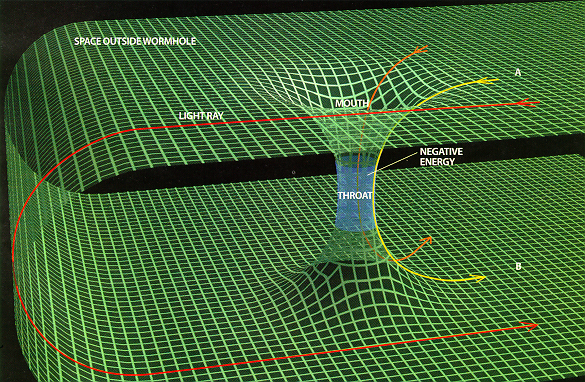
Another way to think about it is because exotic matter has a negative energy, it would have a repulsive gravitational force, since the force of gravity is determined by the mass of the corresponding object. In simple terms it will be able to hold open the wormhole, in simple terms.

Simply put, it is possible to travel through wormholes, provided there is some way to pump in exotic energy.

But many other implications are still present. Where would we get the amount of energy needed to create a black hole, the amount of energy equal to a super nova? If negative energy were to be introduced into the black hole, then the ship traveling within it would have to have protection against this strong force of gravity. Also the fact that as gravity increases, time dilates, or slows down.

There are not many solutions to these other implications, but some solutions are to gather the amount of energy that is required, it can be harvested from an isolated reaction between matter and antimatter. One solution to the force of gravity that would affect the ship would be for the ship to have a gravitational barrier, which would keep the passengers safe. An example of this is the earths gravity field prevents anyone on earth from feeling the pull of the sun.

So conclusively, the ability to travel through wormholes is absolutely possible theoretically, but we are no where near being able to. Another, more closer idea that would allow travel at speeds faster than light is traveling through hyperspace. This idea is similar to wormholes, but not the same concept at all. Hyperspace involves traveling at speeds faster than light by traveling through a space-time bubble. The ship would be traveling in a bubble that contracts space time in front of the ship, while riding the wave of the expansion of this compression.
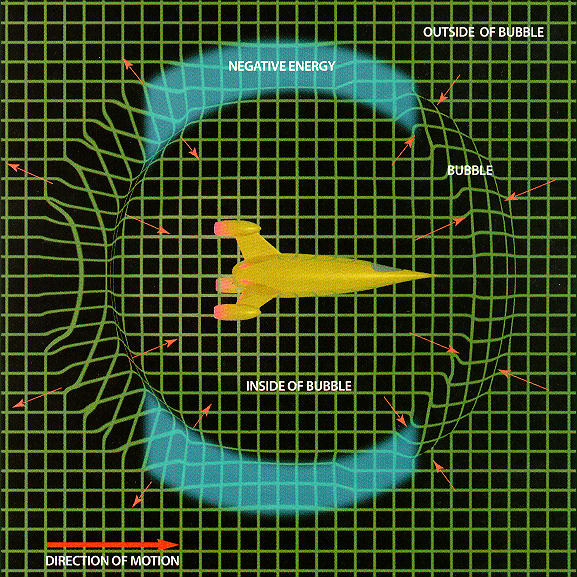

While all these technologies are far beyond our reach, that does not stop us from dreaming. The idea of being able to step through a tunnel on earth and end up in another galaxy within seconds is very science fictional indeed, but the fact that it has been proven through science and studied for decades gives us hope that one day this scientific idea will become reality.

Works Cited
HyperSpace and Wormholes for total idiots. Relicnews forums. Relicnews. 2 July 2004. Web. 19 October 2013.
Lawrence H. Ford and Thomas A. Roman. Negative Energy - Wormholes and Warpdrive-. Biblioteca PLeyades. Scientific America. January 2000. Web. 15 october 2013.
Nola Taylor Redd. What is a Wormhole? Space.com. 29 April 2013. Web. October 10 2013.
http://www.space.com/20881-wormholes.html
http://forums.relicnews.com/showthread.php?28599-Hyperspace-and-Wormholes-for-total-idiots
http://www.bibliotecapleyades.net/ciencia/negativeenergy/negativeenergy.htm


Period 1-Group 7 (Sarah Bien and Amanda Li): Post 3 on Artificial Intelligence


Through our research, our group concluded that AI is indeed a practical form of technology.  Since we have become more aware of AI, it is clear that countless forms of AI already exist.  As technology becomes increasingly advanced, AI at the same time becomes increasingly relevant in our daily lives.  As for robots, however, there is currently much ongoing research and debate surrounding the ethical issues behind making robots more like humans.
For many people, the first thought that comes to mind when one thinks of AI is robots, and that a human-like robot - and therefore the entire concept of AI - is somewhat of a futuristic idea.  While robots do comprise a large portion of current AI research, based on our definition of AI from our first post, it is the “ability of technology to perform tasks that would have previously required human intelligence.”  Basically, anything that is programmed would be considered as AI.  As mentioned in our first post, AI can be found everywhere in our daily lives.  The recommendation programs on sites like Youtube and Pandora are examples of AI.  In addition, video games, voice-recognition software, and credit card transactions are all controlled by AI.  Companies and advertisements also use AI to maximize their sales.  For instance, according to Will Browne, University of Reading, “AI is used in supermarkets to work out what products should be placed with other products, the colour and price the product should be compared to other products, and whether certain products should be stacked vertically or horizontally” (Hilpern)  He says that companies invest large amounts of money in these kinds of technology to help them increase their profits.
Naturally, AI also includes the field of robotics.  Robots have actually been around for a long time.  For example, this video describes the abilities of Shakey in 1969, the very first mobile robot that could reason about its surroundings.  http://www.youtube.com/watch?v=RhrLHkVuerc
Robotics are also employed extensively in manufacturing to increase production output, minimize mistakes, and decrease expenses.  They are also used to “construct our cars, clean our floors and even perform delicate microsurgery on us“ (Hilpern).  AI applications are increasing in the military, agricultural, and healthcare fields (Hilpern).  More recent developments in robotics deal with, as mentioned in our second post, making robots more like humans.  Researchers are looking into the inner workings of the brain, and, through brain emulation, trying to recreate the human brain through technology.  Essentially, they are teaching robots how to learn and giving them emotions so that they can think and feel like humans.  Also gaining attention is the creation of autonomous machines such as driverless cars, pilotless planes, and military drones.  Driverless trains and military drones are already in use, and driverless cars are being announced in the market.   In these cases, AI is operating vehicles and drones and replacing humans’ roles where they were once needed.    
Of course, many ethical issues arise when discussing the humanization of robots and autonomous machines.  Many people fear the domination of the world of a robot species if technology frees itself from human control.  However, military expert Robert Finkelstein assures the public that this will never happen because robots have neither a survival instinct nor the ability to reproduce without human help (Turner).  The mechanization of everything due to advancements in technology causes unemployment because workers are continually replaced by machines.  What happens if a robot has emotions and a human wants to turn the robot off when the robot doesn’t want to be turned off (“The Rise”)?  What are the ethical implications of having a robot as a sexual partner or as a slave (“Robot Ethics”)?  Should robots be considered as individuals and be given the rights of an individual?  As for autonomous vehicles, even though they are theoretically safer than human operators, “should a driverless car swerve to avoid pedestrians if that means hitting other vehicles or endangering its occupants?” (“Morals and the Machine”).  Much of the debate surrounding robot ethics has culminated in a field called machine ethics, which aims to teach machines how to make moral decisions.  However, the author of “Morals and the Machine” suggests collaboration from lawyers, engineers, policymakers, and ethicists to reach standards for the field of robotics.  
AI is a rapidly developing field, and its implications for the future of humankind are tremendous.  Its applications are both feasible and practical, as demonstrated by our research.  In the future, researchers and engineers believe they will be able not only to create a humanoid robot species, but also control the weather, explore the universe, and cure diseases with artificially intelligent medicine.  Even though AI and technology in general seems to be extremely beneficial to the human race, scientists and the public alike should always be aware of the ethical issues behind tampering with humanity.  


An Interesting Podcast on the Ethics of Robots:  http://www.robotspodcast.com/podcast/mp3/robots-20130419-episode128.mp3


Works Cited:
Hilpern, Kate.  “Artificial Intelligence:  Transforming the World We Live In.”  The Independent.  The Independent.  26 Oct. 2007.  Web.  19 Oct. 2013.  
Turner, Bambi.  “10 Ways Artificial Intelligence Will Affect Our Lives.”  Discovery.  Discovery Communications, LLC.  2013.  Web.  19 Oct. 2013.  
“Morals and the Machine.”  The Economist.  The Economist Newspaper Limited.  2 June 2012.  Web.  19 Oct. 2013.  
Lin, Patrick, Keith Abney, and George Bekey.  “Robot Ethics:  The Ethical and Social Implications of Robotics.”  The MIT Press.  MIT.  2013.  Web.  19 Oct. 2013.  

Group Evaluation:

Between Amanda and I, we were able to work together on our posts by using google documents in order to ensure that we all had equal portions of work for each post. We also discovered that our topic was much more elaborate than we expected and found interesting research such as videos and articles to add to our posts. Unfortunately, our work was only between two members, and the other member did not contribute in any of the posts. Even with consistent emails, communication in class, and reminders, the other member was not able to add anything to the work.

Genetics Post #3 Kat, Raisa, Anni


Katie, Raisa, Anni

Through research, we have found that it is in fact possible to use cross species genetics.  Not only is this possible, but it is also a very helpful field of science that can help cure diseases and figure out the evolution of traits among organisms.  This understanding also leads to the ability to alter genes, such as in the GMOs as discussed in post 2.  Genetically modified organisms can have very desired benefits, including resisting insects, viruses, and tolerate herbicides (GMO Facts).  Another important advancement is curing diseases.  Not only Parkinsons can be better understood, but so can many other issues, like bipolar disorder and Alzheimer's (Cell Press and Magnus)
The concept Dr. Connors and Peter Parker explore in The Amazing Spiderman reaches validity with the scientific research of the mouse and human homologous chromosomes.  Research has shown that the neurobehavioral traits of mice and humans are very similar, thus the genes can be overlapping with the same neurobiological mechanisms that deal with bipolar.  Rudolf Magnus, of the University of Medical Center Utretcht, Netherlands, explores how mouse chromosome 15 is homologous with the human gene region 8q24 and chromosome 19 with region 10q23-24 (Magnus).  With Alzheimer’s, scientists have found that the fruit fly and humans share a similarity.  Philip L. De Jager, of Brigham and Women’s Hospital, says that this is an important pathway of the future (Cell Press).
This group project went without any major hassles. There was a collaborative group effort. I do think that there was a lack of communication among group members. In the end, the work was divided up equally.
 
Works Consulted
Cell Press. "Cross-species strategy might be a powerful tool for studying human disease."ScienceDaily,
 
Feb. 2011. Web. 20 Oct. 2013.

“GMO Facts.” Non GMO Project. N.p. Non-GMO Project. Web. 20 October 2013.   

Magnus, Rudolf. “Cross-species genetics converge to TLL2 for mouse avoidance behavior and human

bipolar disease.” US National Library of Medicine. 12 August 2013. National Center for

            Biotechnology Information. Web. 20 October 2013.

Saturday, October 19, 2013

Lightsabers Derek/Carter Episode III: Revenge of the Critics

In order to wield a lightsaber, one of the most dangerous weapons in the universe, one can simply go to their local supermarket and buy a light-up child’s toy (and batteries) that would visually amuse him/her for days. Or you could do what Harvard and MIT scientists did and accidentally create one. Well, actually, what they created was not exactly a Jedi’s weapon of choice, but instead a photon beam that acted as one. The article we talked about in post 2 proved that photons can in fact interact with each other. But this does not make lightsabers feasible, unless you consider majoring in physics at Harvard or MIT “Jedi Training”. 
Only highly trained scientists can operate this kind of energy at this point; and besides, part of the whole allure of a lightsaber is the hilt. Watching the colorful beam of light slowly rise out of the handle is as much a part of a lightsaber as any. And at this point in time in science, getting a controlled photon beam into a hilt is just not feasible.


            This site brings up a lot of problems with the idea of infusing the photon beam with a handle such as creating a short enough blade, controlling the size, and perhaps most importantly, powering the beam. Unlike the toy replica, batteries would not be enough to power a real life lightsaber (this is really the only difference between the two). The only possible way to generate enough energy to power this weapon would be to plug it in to the mains socket. But I assume saber battles would be much less intense if you could not do all the cool jumping and dodging that Jedi do, and instead had to settle with standing right next to each other while you were charging your weapons. You could try unplugging the sabers and fighting with them after they are fully charged, but since photon lasers would burn through energy so quickly, it could turn into 20 second fight sessions, with constant hour-long recharge timeouts. And sizing issues will be a problem. How will these photon beams end. They are not like a stick or anything solid for that matter. They are simply just light beams. The beams used for lightsabers must have a set length created for the saber to actually be weapon and not just a glorified flashlight.


            There is another problem that Carter and I thought of that has to do less with feasibility and more with affectivity. In the movies, the Jedi and their lightsabers dominate their gun-wielding foes. One Jedi can take out 100 gunmen (or gunwomen) just like that. But even if this weapon was created, in modern warfare it would not be effective. The quote “never bring a knife to a gunfight” fits perfectly with this situation. In the battlefield a Jedi would not stand a chance against highly trained soldiers. The only way a Jedi could beat a soldier in combat was if the soldier was this guy:
The only difference would be that saying “your stepfather was slain by a Jedi” would sound a lot cooler than “your stepfather was run over by a steamroller”. But in all seriousness, hand to hand combat would always be trumped by gun fighting. The irony is when we were kids we thought lightsabers were so futuristic and high-tech, but on the battlefield they have the same qualities as swords: outdated and ineffective.

In the movies, George Lucas did not have to think about all these flaws in lightsabers, because he could just use “the force” as the excuse for everything. I mean, how could a 900 year old creature move like this?
The force. That’s how.
But Carter and I sought deeper for the truth, so we went to the most reliable place in the world to research our topic: The internet. We used multiple sites and conversed with each other what argument each site brought up and whether we agreed with it or not. Our initial thoughts were actually pretty accurate: Lightsabers may soon be feasible, but they are not yet.

Time Travel Pt 3 (Alec, Jack, Robert, Max)
After much debate and discussion on many theories and possibilities, our group has determined that the technology of time travel is completely unfeasible. Time travel is defined as “the hypothetical process of moving between past and future”; now depending how you interpret that definition, you may disagree with my earlier statement. As Robert previously posted, time travel at its most basic occurs every day. The clock transitioning from 12:00 to 12:01 could constitute as time travel. However, it’s the virtual definition that comes to mind when we think of time travel. While a one minute change may seem normal, the clock going from 12:00 to 12:02 is a completely different concept. That is just a small magnitude of how we perceive time travel.

Despite many theories and claims, time travel is not possible for one reason. Given the resources and technology we have in 2013, how come it has never happened? Better yet, if time travel is possible how come no one from the year 2034 has travelled back in time to 2013? Time travel is not possible because it goes against the law of physics.

Moving forward to a more factual standpoint, there is an overwhelming amount of evidence that proves time travel is not possible. First, the most well-known data against time travel is an equation. E=MC^2, Energy equals mass times the speed of light squared, an equation that Albert Einstein created to show that nothing can be faster than the speed of light. Physicists in Hong Kong proved that a single proton obeyed this theory, proving that time travel is completely unfeasible. The article goes on to state that “By showing that single photons cannot travel faster than the speed of light, our results bring a closure to the debate on the true speed of information carried by a single photon.” What this means is that these scientists tested the lowest common denominator. They tested the one thing that could of had a chance of actually being faster than the speed of light, since nothing is more pure than a proton. In order for time travel to occur, you must be able to move faster than the speed of light. Since nothing else on this earth can do that, time travel is not possible.

On the contrary, with the constantly changing field of physics and development of technology, who knows what could happen in the future. We most likely won’t be alive to see it, but if technology evolves enough, then time travel may just be a possibility. Although it may not necessarily lead to time travel, one possibility is solving the mystery of how certain particles “communicate with each other instantaneously with each other faster than the speed of light.” This could lead to a development in time travel.


Works Cited:

Howell, Elizabeth. "Time Travel: Theories, Paradoxes & Possibilities." Space.com. N.p., 21 June
2013. Web. 19 Oct. 2013.

AFP. "Discovery News." DNews. N.p., 24 July 2011. Web. 19 Oct. 2013.

Porter, Kevin. "Why Time Travel Is Impossible." HubPages. N.p., n.d. Web. 19 Oct. 2013.

"Einstein's Theory of General Relativity." Space.com. N.p., n.d. Web. 19 Oct. 2013.

Hovercrafts #3


Hovercrafts from The Hunger Games
Final Post 10/19/2013
Kayla Durkin & Mikaela Cruz, Period 7 Goldner

A Capitol Hovercraft
Our initial assumptions on the hovercraft’s feasibility in our world today have been both validated and debunked through further research. Although we mentioned that the United States currently uses drones (see post #1), which are similar in terms of stealth, a hovercraft that is able to cloak itself, is not in our near future. Due to complications regarding technologies necessary to reach an advanced aircraft much like the Capitol’s in The Hunger Games, the hovercraft is likely to remain a hybrid vessel, at least in our time.
We agreed upon its feasibility initially because we did not consider the distinction between physical invisibility, and its undetectability --- stealth and noiselessness. As a result of naturally occurring materials’ incapacity to bend the light around an object, and obstruct the production of a reflection, scientists are still in the process of creating materials that will be able to carry out the function that will work on a larger scale (Graham-Rowe). Consequently, the costs will be excessive. In 2006, British and American researchers unveiled plans for the creation of a cloaking device. Professor John Pendry concluded that the cloaking device could have potential in the military stealth technology. However, “engineers have not yet been able to create the materials that could be used to cloak an aircraft or a tank,” he said (BBC News). These are major factors that will greatly impact the hovercraft’s potential feasibility in our society. While they seem invariably impossible at this moment, we believe that it will be possible to produce such versatile aircrafts SOMEDAY. There is currently no infallible evidence that could suggest that they are feasible as of right now.
On a more positive note, we were correct to assume that hovercrafts can be used in the military. Although we speak of the modern-day hybrid vessels, they have shown to harbor equally potent weapons of mass destruction. The Russian Army has a military hovercraft weighing about 550 tons. In August 2013, a Zubr-class hovercraft, which is said to carry advanced weaponry and transport destructive tanks made an emergency landing on a beach in Kaliningrad, Russia (The Week). Hovercrafts intended for warfare are undeniably more expensive and difficult to manufacture. However, engineers have done multiple how-to videos on building your own hovercraft for recreation!

Build and Ride Your own Hovercraft:


The Process and Our Collaborative Effort:

Kayla and I split the work evenly; we both contributed to what each post would contain context-wise while we were able to each choose which images we could use for the posts under our account(s). We were very disappointed upon doing research because we both enjoyed about learning the possibility of a powerful aircraft such as the ones in The Hunger Games (which we both LOVE) and ultimately finding out that it is not even possible. We did equal amounts of research and picked out which specific relevant points we could use to make a valid argument pertaining to the hovercrafts' feasibility and we both agree that the best part about our collaborative effort was learning about how the hovercraft is being used in the military and daily life.  

Works Cited:

BBC. "Plan for cloaking device unveiled." BBC News - Science and Environment. BBC, 25
May 2006. Web. 19 Oct. 2013.

Gayomali, Chris. "Enormous military hovercraft makes emergency landing on crowded  
Russian beach." The Week. The Week, 22 Aug. 2013. Web. 19 Oct. 2013.

Graham-Rowe, Duncan. "How to Make an Object Invisible." Technology Review.                   
         Massachusetts Institute of Technology, 11 Apr. 2007. Web. 19 Oct. 2013.

Faster-Than-Light Travel 3


-from A Wrinkle in Time


Faster-than-light travel is the travel through space faster than the travel of light. An important note is that an actual speed exceeding that of the speed of light is not necessary for faster-than-light travel; in fact, most techniques for traveling faster than light do not involve exceeding C, the speed of light. The first technique is the Cherenkov Effect. The Cherenkov Effect is the fact that light moves slower in a medium such as air, water, or glass than in a vacuum like space. This means that it is possible to outpace light in such a medium without surpassing C, as C only applies for light in a vacuum. A shadow or light spot can change faster than light if the light beam projecting them is far enough away and is moved. In a rocket moving at close to the speed of light, time on their ship would slow down according to special relativity, causing the calculation of speed over time (velocity) relative to the passengers of the rocket to be faster than light. However, as light is not actually travelling at the speed of light C in the first scenario, no information or objects are able to be transmitted in the second scenario, and the rocket does not exceed the speed of light to an outside observer no witnessing the slowing of time in the third scenario, none of these are considered true faster-than-light travel. Most methods of theoretical faster-than-light travel feature the same flaws as these.
Other theoretical methods of faster-than-light travel run into different flaws. The first is universal expansion. The expansion of the universe moves objects inside it, allowing objects to be pulled in opposite directions in such a way that a third party observer would see the distance between them increasing at a speed faster than that of light. However, the objects themselves would not register velocities above those at light. This is generally not considered true faster-than-light travel, however, as it does not allow any object to actually travel across the galaxy faster than light could, and instead only allows faster-than-light travel in relation to a cosmic reference frame. There are other supposed instances of faster-than-light travel using reference frames, such as the speed in which the moon orbits over one’s head as one rotates with the Earth, but these run into the problem that space and time alone are relative. The object itself, such as the moon, would not actually experience itself outpacing light; the observer on Earth is just considering himself at rest when in fact he is the one moving with the rotation of the Earth. Neither of these examples work as a usable faster-than-light travel mechanism.
There are actual methods of travelling faster-than-light, however. The first is through the use of wormholes. A wormhole in space-time artificially shortens the distance in space-time an object must travel to reach its destination, allowing it to travel between two points faster than light would in a straight path through the normal configuration of space-time. The book A Wrinkle in Time describes such motion as a tesseract, where space-time is folded to allow distant points to touch each other. However, the energy requirements for holding open such a wormhole make such a feat impractical and possible unachievable outside theoretical speculation. Another method for achieving faster-than-light travel is the warp drive. Popularized in Star Trek, this method would warp space-time in such a way that the object would actually be pushed through space at a speed faster than light. The object would reside inside a stable bubble of space-time to prevent the space-time warping required for such motion to harm the transmitted passengers or information. Mexican physicist Miguel Alcubierre actually determined a theoretical method for achieving such travel in 1994 by contracting spacetime in front of a vessel and expanding space-time behind it to create a wave of space-time that the vessel rides on to exceed light speed. The process ran into the problem that it would require energy usage equivalent to the mass of jupiter, but Harold White, a physicist at NASA, discovered a way to reduce the energy requirements to the equivalent of the mass of Voyager 1 by altering the shape of the spacecraft, and theorized that it would be possible to decrease the requirements even more by oscillating the warpage of space-time. NASA is currently working on developing such a spacecraft. However, such travel requires the violation of certain energy rules. Also, the spacecraft is inside a space-time bubble for the duration of the faster-than-light travel, so the entire trajectory must be planned out  beforehand, a process that may itself require faster-than-light travel. These issues, among others, have made some scientists doubt that a warp drive can ever be plausibly created. Many others see these problems as surmountable, and much progress has been made in the last couple of decades. That being said, both of these methods of faster-than-light travel only outpace light because they use a different method of travel through space-time; if the same circumstances of travel were applied to light as to the beneficiaries of these methods instead of comparing the methods to light traveling through normal space-time, light would outspeed them. In this way even the most promising methods of faster-than-light travel cannot be said to be truly travelling faster than light.
In fact, true faster-than-light travel -- travel that would beat light in a straight-up race in normal space, is theoretically impossible. Special relativity states that the combined motion through space-time is equal to the speed of light. When one is at rest in space, one moves through time at the speed of light, and when one moves through space at the speed of light, one is at rest in time. Therefore, moving in space faster than the speed of light would require moving backwards in time to maintain the balance. This leads to the Grandfather Paradox. If one could travel back in time, then they could meet and kill their grandfather, preventing themselves ever having been born. But if they had never been born, they never could have traveled back in time to kill their grandfather. This paradox is widely used to disprove time travel to the past. However, it therefore could also be said to disprove faster-than-light travel. So although there are many techniques to create the appearance of travelling faster than light, and some even to give the practical effects of travelling faster than light, actual faster-than-light travel can be written off.


Anderson, David Louis. “Alcubierre Warp Drive.” The Anderson Institute. The Anderson Institute,
(n.d.). Web. Accessed on 19 October 2013.
Gibbs, Philip. “Is Faster-Than-Light Travel or Communication Possible?” Physics FAQ. Updated
1998 by PEG. Philip Gibbs, 1997. Web. Accessed on 19 October 2013.
L’Engle, Madeleine. “Tesseract.” Book. math.brown.edu. Lisa Hicks, 19 June 1996. Web.
Accessed on 19 October, 2013.
Peckham, Matt. “NASA Actually Working on Faster-Than-Light Warp Drive.” Time Tech. Time
Inc., 19 September 2012. Web. Accessed on 19 October 2013.